The concepts
The framework in ten slides
One argument in ten steps, from the trader's mistakes to the structure that replaces prediction.
Watch · 4 minutes
Prefer to read? Go through the ten slides · Watch on YouTube
Read the transcript
Introduction
Eighty to ninety percent of independent leverage traders lose money. Not because they know too little. Because they believe they know. This is a framework built on the opposite idea: you don't need to know.
The Fallacy of Knowledge
The market's path cannot be known. Yet we act as if it could. As Nobel laureate Daniel Kahneman put it: what you see is all there is. Then we find good stories to explain the past, so it feels inevitable. And from that false understanding of the past, we believe we can predict the future. Those expectations become positions. Losing trades are held. Contrary price is dismissed as noise.
Your Own Unknown
So, what do we actually know? Not the future. Not the value of price. Not the path. Two traders look at the same chart, and they see two different markets. Each of us draws our own line between known and unknown. The known is expectations wearing certainty.
Emotions Mistaken for Signals
Not knowing feels uncomfortable. The mind fills the gap with feelings: fear, urgency, comfort. They feel like market data. But they are only information about you. The error is taking an emotion for a signal. The price sequence is the only signal.
You Don't Need to Know
You don't know where the market is going. Then, you don't want to know either, because every forecast breeds expectations. And finally, you don't need to know, because the price sequence shows you what is actually happening. Read the price sequence as it unfolds, and act on what is, not on what might be. Your edge is not foresight. It is responsiveness.
Trade Risk, Not Price
Without a forecast, what is left to trade? Risk. You choose a structure, never a direction: an entry, a stop-loss, a realization. You trade a segment, not the move. And risk has a precise meaning: the estimated probability that price reaches your stop-loss before any realization. So, the path matters. Two trades can end at the same price with opposite results. Survive the route, not the destination.
The Cost of Staying in the Game
Without a stop-loss, one adverse move can end the game. But the stop-loss has a price. Touching the stop-loss is far more likely than finishing beyond it, and many stopped trades would have recovered. That is the toll for your survival: small known losses instead of ruin.
Restoring Symmetry
The stop-loss enforces the loss automatically. Nothing enforces the gain. Unrealized profit can vanish. The gain must then be made as binding as the loss. So, lock both sides. Because a mandatory stop-loss demands a mandatory take-profit.
Performance Lies in the Unknown
Yet something must pay for all those small losses. It is the rare trade that runs far beyond what you expected, into the unknown. The unknown is not the risk you tolerate. It is the asset that you trade.
Structure Is the Trade
Take profit, or let it run? Do both. Split the position. The realized portion pays for the runner. And every response is set before the position exists. Structure bounds the cost, never the outcome. It is what lets you stay exposed to the unknown.
Doing the Right Thing
One trade's result proves nothing. Outcomes belong to the market. What belongs to you is conduct: the right expectations, the right thinking, the right behavior, and rules you never break. Not outcome. Conduct.
The book
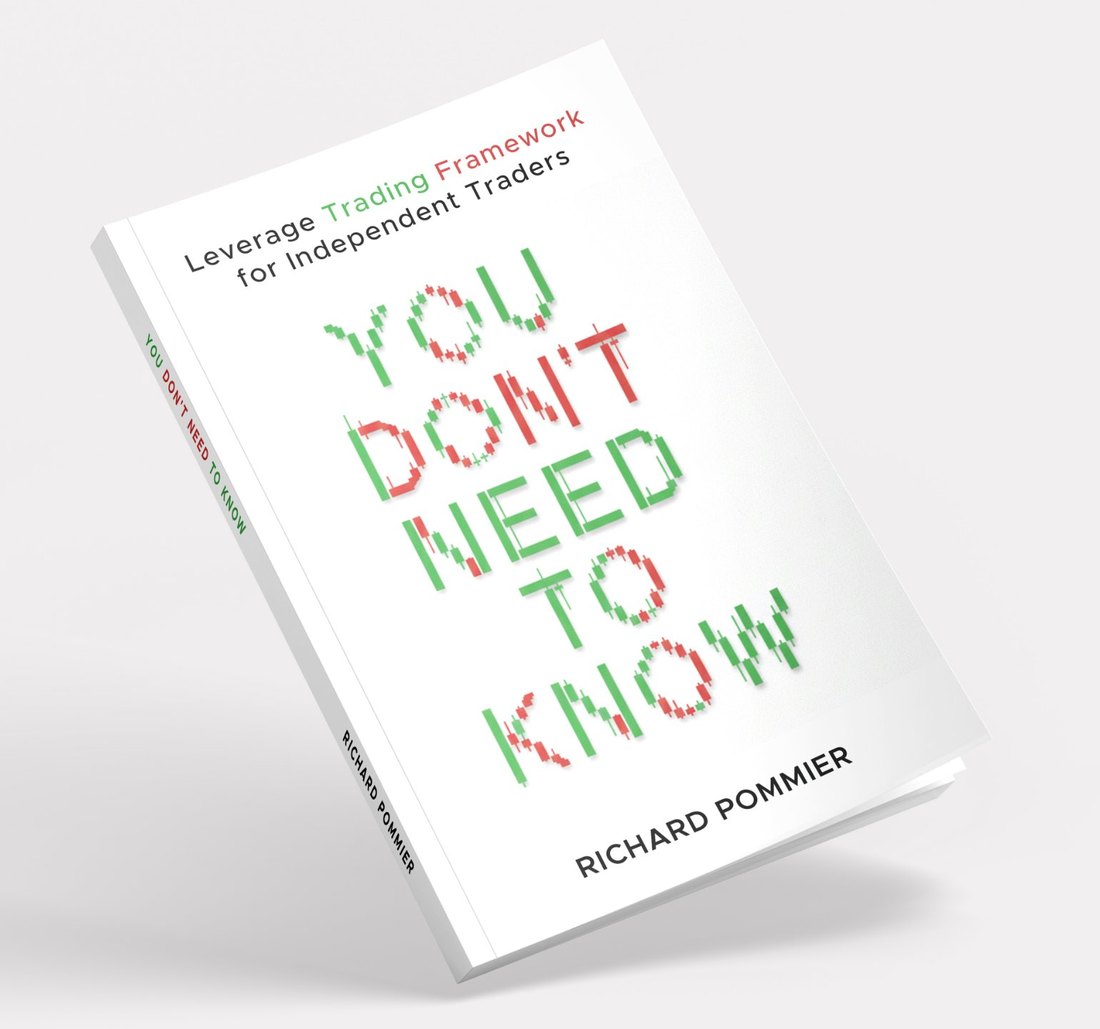
You Don't Need to Know. A leverage trading framework for independent traders. Available on Amazon.
Part one · The trader
The Fallacy of Knowledge
All ten slides