Most leverage traders survive only a few years in the markets. A key reason, we believe, is their failure to grasp how leverage fundamentally changes the game. Leverage does not only amplify returns—it reshapes the risk landscape through the risk of ruin.
Leverage traders operate under constraints, incentives, and risks that are entirely different from those of investors or professional traders. As such, leverage traders are not merely using leverage, they are operating within an entirely different game.
Leverage trading is defined as much by leverage itself as by the market it interacts with. When trading with leverage, the primary objective is not to match conventional performance metrics such as indexes returns. The goal is to extract profit wherever it appears and in whatever form it manifests—a tick is always worth the same wherever it occurs within the price action.
Within this perspective, we identify the value1 pillars that support leverage trading performance. They do not simply accumulate—they converge. The unknown supplies the performance. The price sequence is where it becomes readable. The stop-loss and the take-profit impose the boundaries that survival under leverage requires. Trade structure binds those boundaries into an assessable risk2 event. Technical analysis, market structure, and narrative are the instruments through which those values are located, contextualized, and understood.
We begin with the most fundamental—and counterintuitive—of these pillars: the unknown itself. Not as a risk to be managed, but as the structural source of performance.
Value of Unknown
Shared Ignorance
Unpredictability of Markets
Markets are unpredictable. Primarily, markets are complex, adaptive systems shaped by countless participants—each pursuing distinct objectives, guided by shifting beliefs, and operating with incomplete information that remains largely opaque to everyone else.
Markets operate on a shared ignorance of an unknowable future. No one knows what real-world events will unfold or how they will ripple through markets. There is no map of liquidity or positioning that can reliably forecast how the market will respond to price movements.3 Therefore no one can predict how market participants will respond as conditions evolve, or how the resulting reflexive flows will feed back into and reshape the market.
Finally, even if a forecast proves correct in hindsight, the path the market takes to reach that outcome is inherently uncertain. A leverage trade can still fail long before the target is ever reached.
“Unforeseeable events are bound to occur, and the consequences of these unforeseeable events are also unforeseeable. As a result, objective ignorance accumulates steadily the further you look into the future”.
Daniel Kahneman, Olivier Sibony and Cass R. Sunstein
- Noise. A flaw in human judgment -
What is the Unknown?
Markets’ Black Holes of Understanding
The unknown reflects both the limits of our knowledge, but also the constraints of how we process market information.
Our thinking tends to be linear—built on clear cause-and-effect relationships and stable dependencies—which makes it poorly suited for interpreting markets. We prefer worlds where 1+1=2 and relationships behave predictably. In markets, though, 1+1 might equal 2.5, 3 or nothing at all. Well-documented phenomena such as reflexive interactions, threshold-driven asymmetries, and liquidity-based inelasticities give markets a distinctly nonlinear character.
These dynamics create markets black holes—blind spots in the market’s possible trajectories where both our knowledge and our cognitive tools fail us.
The Known, Expectations Wearing Certainty
The unknown is not a standalone concept—it exists only in opposition to a known. To speak of the unknown, we must first define the known against which it stands. And here trading presents a problem: what, exactly, does a trader know?
Not the future—markets operate on a shared ignorance of an unknowable future. Not value—price carries none. Not the path—even a correct forecast says nothing about the route the market takes to reach it. Strip these away and no factual knowledge of what comes next survives.
What survives is expectations. What the trader experiences as the known is not knowledge of the market but the body of expectations they bring to it—beliefs about what is likely or supposed to happen. Beliefs harden into expectations, and expectations present themselves with the feel of knowledge. The known is expectations wearing certainty.
This definition carries an immediate consequence. The boundary between known and unknown is not drawn by the market—it is drawn by the trader. The known extends exactly as far as expectations reach; the unknown begins where they end. Both sides of the line are made of the same material: the trader’s own mental constructs.
The Unknown is Your Own Unknown
If the known is nothing more than our expectations, then the unknown follows by the same logic: it is everything our expectations fail to capture. Neither is an intrinsic property of the markets. The unknown does not sit somewhere out there, waiting in the order book—it begins precisely where each trader’s expectations end.
From the Kantian framework4—Markets are in themselves. Knowledge is not a mirror of the world but a structured interaction between mind and world. How they appear arises from the observer’s position, i.e. the trader’s position. What any trader perceives as market behavior is a function of their own expectations, exposure, timeframe, and interpretive framework—not an objective property of the market itself.
The practical consequence is precise: two traders looking at the same price action do not see the same market. They see their own known—their expectations—and, beyond its frontier, their own unknown, shaped by everything they bring to the screen.
Since known and unknown are made of the same material, the unknown has no less materiality than what we experience as the known. The unknown must therefore be treated on the same basis as the known. It belongs on equal terms, as an integral part of the whole we trade.
In trading, the unknown is not merely a source of risk but a source of performance equal to the known. To price it at zero—to treat it as the residue left once the analysis stops—is to write off most of the trading landscape. The unknown is not what the strategy excludes; it is the domain the strategy exists to navigate. Any boundary between the two is the trader’s own, and everything beyond it is performance they have agreed not to have.
Performance Lies in the Unknown
Asymmetrical Edge
Most trading frameworks treat the unknown as the problem. We argue it is an asset. The unknown is the asymmetrical edge of the leverage trader. Because losses are forced—by design—to avoid the risk of ruin, then performance becomes tied to the open-ended potential of the unknown to counterbalance the cost of the trades being forcefully stopped out. In leverage trading, many trades are stopped out and only a few survive. Only the rare winners allowed to run can pay for the many small losses.
A trader can never know in advance how far a winning position might run or when it will reverse. Unlocking this value requires holding positions long enough for the market to reveal what it has to offer. There is only one solution—letting the market reveal the unknown. The unknown is not a risk the leverage trader tolerates but the asset they trade.
If the unknown is the asset, then the price sequence is the medium through which that asset reveals itself. Price not as a predictor, not as a measure of value, but as a continuous, observable conversation between market participants.
Value of Price Sequence
What is the Value of Price?
Price has no Value
In financial markets, it is tempting to treat the current price as a reliable signal of value. Prices fluctuate constantly, and human nature compels us to find meaning in every tick. Yet this intuition can be deceptive. Price levels, when viewed in isolation, do not carry any information. They reflect momentary imbalances in buying and selling—not enduring fundamentals.
Evidence of price’s lack of informational value shows up most clearly at market extremes. Stocks frequently rocket on viral hype only to crash shortly after—as exemplified by the pronounced boom-and-bust dynamics observed in the post-IPO period. We can also observe commodity markets trade below zero.5 Some argue that such distortions appear only at extremes—but how can we meaningfully define what a normal market even is?
Rather than any stable notion of value, in these moments price reflects sentiment, positioning and supply and demand forces of market participants, all of whom act on their strategies, information, and expectations—price is the current equilibrium snapshot.
Price is Actionable
By the time a price appears on the screen, it has already absorbed what’s known or believed by market participants. In that sense, price is backward-looking: it shows where the market agreed to trade, not where it is headed. If a simple, repeatable relationship existed between today’s price and tomorrow’s move, it would be arbitraged out instantly. Traders would exploit the pattern until it vanished under the weight of its own predictability.
Therefore, price is not a signal about the future from the market—price is not a forecast. Price is simply the level where you can decide to act right now. It shows you, at this moment, you can buy here or sell here, and nothing more—price is actionable.
Looking for Value in Price Sequence
What is a Price Sequence?
A price sequence is the continuous unfolding of price over time, expressed as a series of swings, pauses, and transitions in a defined timeframe. It shows the ordered progression of market behavior, from expansion to contraction, from impulsive moves to corrective pullbacks, from accumulation to distribution. The price sequence can be interpreted as a narrative, revealing where the market has been and where it currently stands.
Each price sequence develops its internal rhythm defined by:
Phases—Periods of impulse and consolidation.
Structure—Arrangement of highs, lows, ranges, and breakouts.
Context—Shifts in sentiment, positioning and liquidity.
Value of Price Sequence
When prices fluctuate, it triggers shifts in liquidity and positioning across participants. Each fluctuation redefines the immediate risk balance of participants forcing them to adjust in response and creating a self-reinforcing dynamic: price action alters positioning, positioning alters liquidity pressure which feeds back into the next price move:
price action → positioning → liquidity pressure → price action.
In effect, the price sequence becomes a real-time expression of how risk transfer and liquidity interact and evolve. As a consequence, this makes the price sequence a source of probabilistic insight: not because past prices predict future prices, but because they shape positioning which in turn influences the price.
Price action can thus be read as a chain of conditional probabilities: given what has just happened (A→B→C), what is the likelihood of (D) happening? Each price sequence can therefore be interpreted as a series of probabilistic projections for the next move, with each new observation refining the series of probabilities.6
Identifying Patterns within Price Sequences
Traders must then shift their focus to the forces behind the price sequence. The edge lies in price dynamics—in how prices move and how market participants are likely to respond. Patterns emerge because human behavior tends to cluster, repeat, and react in similar ways. These dynamics offer the closest thing to insight. The practical task for the leverage trader is therefore to identify actionable patterns within price sequences.
Much like a seasoned poker player prioritizes the cumulative progression of the hand—the sequence of betting from the opponents—rather than reacting solely to the last wager, value lies in the conversation. One must look beyond the current price and interrogate the pressure that shaped it. By focusing on how prices behave, rather than what prices could indicate, traders develop strategies based on observable market dynamics rather than speculative narratives.
Furthermore, for leverage traders who face the risk of ruin, the order of price moves can be as critical as their magnitude. Analyzing price patterns helps traders anticipate path-dependent risks.
Leverage trading is a series of probability distributions - but you only ever trade one. Each trade is a distribution of possible outcomes: a best-guess model of how the risk event may resolve, inferred from the current price sequence. Only the present trade has a shape you can actually read. Future distributions depend on price sequences that have not yet unfolded; the further ahead they lie, the less the current sequence can say about them. You trade the front of the series - the only distribution grounded in information available now.
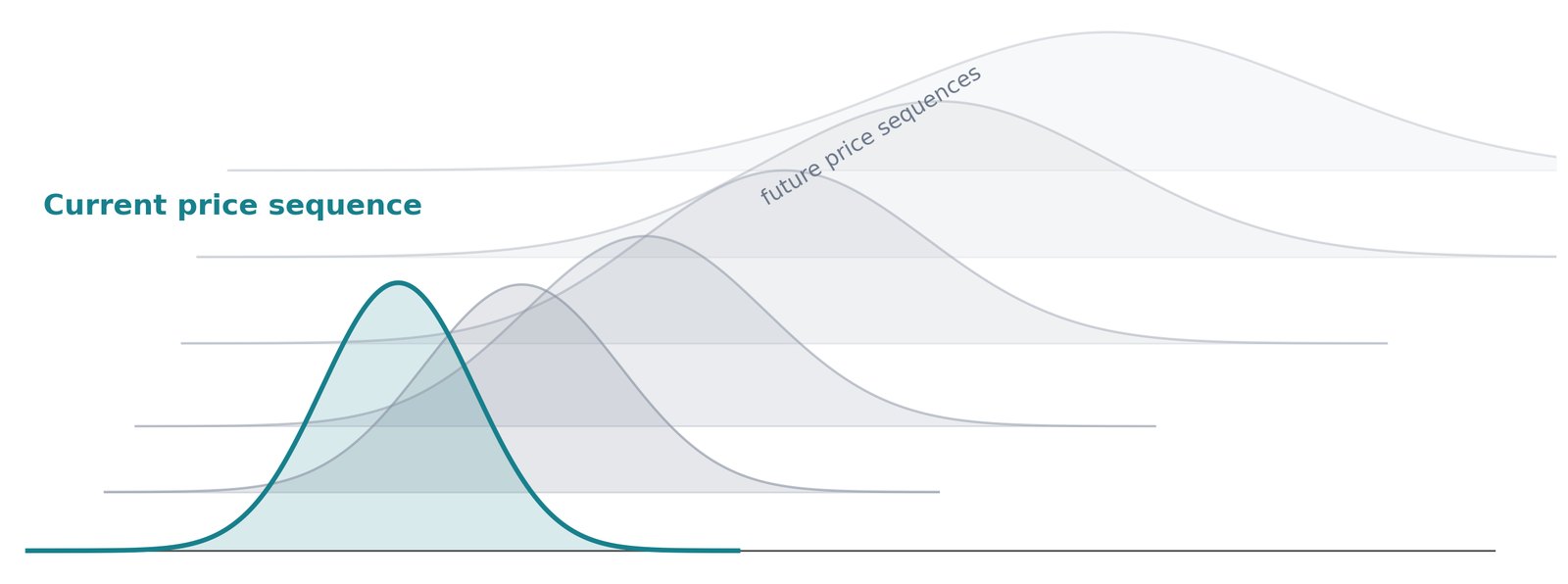
Only the current price sequence can be read; future sequences are real but unwritten.
Recognizing value in the price sequence is necessary—but not sufficient. A pattern is only an observation. To carry risk, it must be given shape—this is the trade structure. Before defining it, we must understand the forces that make trade structure necessary.
In the rest of the chapter
You are reading a free sample of You Don't Need to Know. To read the rest of the book, get your copy on Amazon.